


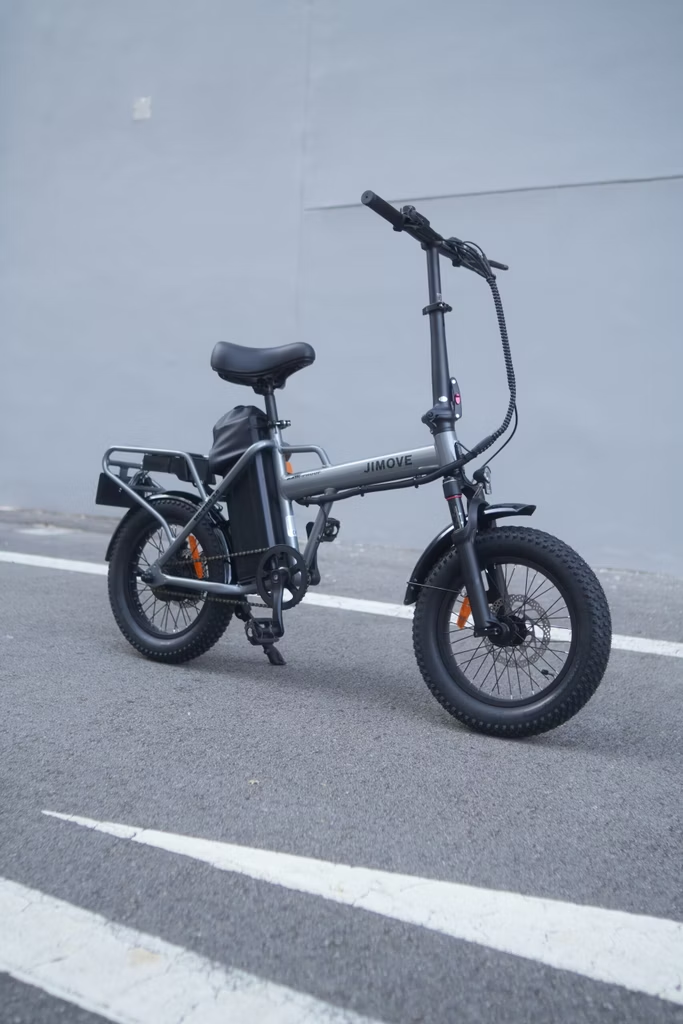
If you’ve been searching for the best ebike in Singapore, there’s a good chance you’ve already come across the Jimove MC Pro name. It’s been Singapore’s top-selling ebike for good reason — built for our tropical climate, LTA approved, and trusted by thousands of daily commuters and food delivery riders alike.
But now there are two versions: the Jimove MC Pro 2.0 and the newer Jimove MC Pro 3.0. Which one should you buy?
This guide breaks down the real differences between the two — not just the spec sheet, but what it actually means for your daily ride in Singapore.
Quick Answer: 2.0 or 3.0?
- Buy the MC Pro 2.0 if: you want the proven, best-value ebike — foldable, long-range, and great for commuters, recreational riders, and anyone who needs to store their ebike in an HDB flat or carry it in a car.
- Buy the MC Pro 3.0 if: you’re a delivery rider or long-distance commuter who prioritises ride comfort via air suspension and doesn’t need the bike to fold — you’ll park and lock it outside.
Now let’s get into the details.
Jimove MC Pro 2.0 vs 3.0 — Key Differences at a Glance
| Feature | MC Pro 2.0 | MC Pro 3.0 |
|---|---|---|
| Price | $1,699 | $1,799 |
| Suspension | Standard front fork | Air suspension (front only) |
| Battery | 48V 19.2Ah | 48V 19.2Ah |
| Estimated Range | Up to 120 km | Up to 120 km |
| Tyre Size | 16 x 3″ fat tyre | 16 x 3″ fat tyre |
| Frame | Double-welded, foldable | Double-welded, non-foldable |
| Rainproof Warranty | ✅ Yes | ✅ Yes |
| LTA Approved | ✅ Yes | ✅ Yes |
| Best For | Commuters, recreational riders | Delivery riders, long-distance riders |
Suspension: The Biggest Real-World Difference
This is where the MC Pro 3.0 earns its $100 premium.
The MC Pro 2.0 uses a standard front suspension fork — perfectly adequate for Singapore’s roads, PCNs, and HDB cycling paths. Most commuters riding 20–40 km daily will find it comfortable enough.
The MC Pro 3.0 upgrades to a front air suspension fork. If you’ve never experienced air suspension on an ebike, the difference is immediately noticeable — especially on uneven tarmac, road humps, and the rougher sections of park connector networks. The front air fork absorbs road shock before it travels up through the handlebars, reducing wrist and shoulder fatigue significantly. For delivery riders doing 60–100 km shifts, that reduced vibration across hundreds of kilometres per week adds up significantly.
Bottom line: If comfort over long distances or rough terrain matters to you, the 3.0’s front air suspension is worth every dollar of the difference.
Battery & Range: How Far Can You Go?
Both the MC Pro 2.0 and 3.0 share the same 48V 19.2Ah battery, delivering up to 120 km per charge under normal Singapore riding conditions. This is one of the highest range figures among LTA-approved ebikes on the market — enough for most delivery riders to complete a full shift without needing to recharge mid-day.
For the average commuter riding 15–25 km per day, you’d only need to charge once every 4–5 days. For delivery riders doing 60–100 km shifts, the 120 km range comfortably covers a full working day with buffer to spare.
Since both models share the same battery, range is not a deciding factor between the two. Your decision comes down to the other differences — suspension, foldability, and price.
Build Quality & Foldability: A Key Practical Difference
Both models share Jimove’s signature double-welded frame — one of the key reasons the MC Pro became Singapore’s best-selling ebike. Early single-weld frames from competitors were prone to cracking at the fold joint under heavy daily use. Jimove’s double welding addressed this directly.
Here’s the important difference though: the MC Pro 2.0 is foldable; the MC Pro 3.0 is not.
This matters more than people initially think. If you live in an HDB flat, need to bring your ebike into a lift lobby, load it into a car boot, or store it in a tight space at work — the MC Pro 2.0’s foldable frame gives you far more flexibility. The 3.0’s non-foldable frame makes it bulkier to store and transport.
The trade-off is that the 3.0’s rigid non-folding frame combined with the air suspension fork is optimised for sustained performance under heavy use — which is why it suits delivery riders who typically park and lock their ebike outside rather than carrying it upstairs.
Both models feature the same 16 x 3″ fat tyres, providing excellent grip on wet Singapore roads and stability on uneven surfaces. Both also carry Jimove’s rainproof warranty — a genuine differentiator in a market where most competitors void warranty on water damage.
Price: Is the $100 Difference Worth It?
The MC Pro 3.0 costs $1,799 versus $1,699 for the MC Pro 2.0 — a $100 gap.
Given what you get — air suspension and a larger battery — the MC Pro 3.0 is genuinely good value at that difference. The question is whether those upgrades match your actual riding needs.
If you’re a daily commuter or recreational rider, save the $100 and put it toward an ebike accessory like a quality helmet or rack. The MC Pro 2.0 does everything you need.
If you’re a delivery rider or long-distance commuter, the MC Pro 3.0 pays for itself over time through reduced fatigue and fewer charge cycles required per shift.
Both models are available on ebike installment plans — including Fundbox Easyride (up to 24 months), 0% credit card installments, and BNPL options through Grab and Atome — making either model accessible without paying the full price upfront.
Who Should Buy the Jimove MC Pro 2.0?
- First-time ebike buyers who want the best proven model at the best price
- Daily commuters who need to fold and store their ebike at home or at the office
- HDB residents who bring their ebike into the lift or store it in a flat
- Anyone who loads their ebike into a car regularly
- Recreational riders using PCNs on weekends
- Riders who want a long 120 km range in a versatile, foldable package
Who Should Buy the Jimove MC Pro 3.0?
- GrabFood, Foodpanda, or other food delivery riders doing long daily shifts
- Long-distance commuters who prioritise ride comfort over portability
- Riders who regularly encounter road humps, uneven paths, or rough terrain and want front air suspension to absorb the impact
- Riders who park and lock their ebike outside — where foldability matters less
- Anyone who wants the most comfortable ride possible at a modest $100 premium
Can I Test Ride Both Before Buying?
Yes — EkoLife offers free test rides on both the Jimove MC Pro 2.0 and 3.0 at our outlets in Tai Seng and Canberra. We recommend riding both back-to-back if you’re on the fence. The air suspension difference on the MC Pro 3.0 is something you feel immediately, and a 5-minute test ride will tell you more than any spec comparison.
WhatsApp us to book your test ride slot — our team will walk you through both models and help you choose based on your actual riding needs.
Already Have an Older Jimove? Consider a Trade-In
If you’re currently riding an older Jimove model or a different ebike brand, EkoLife offers trade-in values of up to $800 toward your upgrade to either the MC Pro 2.0 or 3.0. You can also browse our range of used ebikes in Singapore if you want a Jimove at a lower entry price.
Final Verdict
Both the Jimove MC Pro 2.0 and 3.0 are excellent ebikes — LTA approved, rainproof warranty, double-welded frame, fat tyres, and backed by EkoLife’s local after-sales service. You can’t go wrong with either.
The MC Pro 2.0 is Singapore’s best-value all-round ebike. The MC Pro 3.0 is the delivery rider and long-distance commuter’s best friend.
Ready to make your move? Visit us at EkoLife Tai Seng or Canberra, or browse the Jimove MC Pro 2.0 and Jimove MC Pro 3.0 online and WhatsApp us to get started.
Frequently Asked Questions
Is the Jimove MC Pro 3.0 LTA approved in Singapore? Yes. Both the Jimove MC Pro 2.0 and MC Pro 3.0 are fully LTA approved for use on Singapore roads, cycling paths, and park connector networks (PCNs). They come with the orange LTA seal and number plate.
What is the battery and range of the Jimove MC Pro 2.0 and 3.0? Both models share the same 48V 19.2Ah battery with a range of up to 120 km per charge. Battery and range are identical between the two — the differences lie in suspension and foldability.
Is the Jimove MC Pro 3.0 foldable? No. The MC Pro 3.0 is non-foldable. The MC Pro 2.0 is foldable with a double-welded frame. If you need to store your ebike in an HDB flat, lift, or car boot, the MC Pro 2.0 is the better choice.
What suspension does the Jimove MC Pro 3.0 have? The MC Pro 3.0 features front air suspension. The MC Pro 2.0 uses a standard front fork. Neither model has rear suspension.
Where can I buy Jimove MC Pro in Singapore? EkoLife is an authorised Jimove retailer with outlets at Tai Seng and Canberra. Test rides are available. You can also order online via our ebike Singapore page.
Does Jimove MC Pro come with a warranty? Yes. Jimove MC Pro models come with Jimove’s rainproof warranty — one of the few ebike brands in Singapore that covers water damage, which is particularly important in our tropical climate.
Can I get a Jimove MC Pro on installment? Yes. EkoLife offers Fundbox Easyride (up to 24 months), 0% credit card installments (12 months), and BNPL via Grab and Atome. See our ebike installment plans for full details.
Wah, the air suspension on 3.0 really sound shiok for delivery riders who cycle long hours. But I agree, if just normal office commute, 2.0 can already, no need pay extra for features we don’t use.
Honestly, both Jimove MC Pro 2.0 and 3.0 are superb options for riders here. The fact that both share the same excellent range and rainproof warranty makes either choice a good investment. For HDB dwellers or office workers, the foldable frame of 2.0 is so practical, especially with space always a concern in Singapore.
The 3.0’s front air suspension is a very nice upgrade for delivery riders or those cycling extra long distances—it really helps with comfort, reducing wrist and shoulder pain. I like that the review is practical and tells you when each feature really matters in daily life, not just listing specs. Feels like you can’t go wrong either way depending on your needs!
Junhao, I’m not fully convinced it’s such a close call. The lack of foldability on the 3.0 is a big sacrifice for most Singaporeans—even if you want comfort, does it make sense to buy a bulkier bike when you might need to bring it home or take it in the lift? Also, $100 more for just air suspension doesn’t seem like enough to justify losing all that flexibility.
Good point, Siti. But actually, many delivery riders park and lock their bikes outside, so foldability isn’t top priority for them, while long hours mean comfort really counts. For average commuters, yes, the 2.0’s foldability wins, but for the specific use case of delivery or long trips, the comfort trade-off makes sense—it’s not just paying for a small feature, but for a noticeably better daily ride.
I see your point, Junhao. If you never need to bring the bike upstairs, then maybe the 3.0 comfort worth it in the long run. But for people who don’t do food delivery, 2.0 still sounds safest.
That’s fair, but I think Siti’s right that most of us want flexibility. Plus, 2.0 already has decent suspension. Is the air fork really so much better for $100 more?
I agree with Siti. Most HDB residents I know complain about moving bulky bikes around lifts and corridors. 2.0 is more practical for daily life, even if you sometimes wish for more comfort.
But what if people want both comfort and foldability? Not everyone fits so neatly into either group. Why can’t they make a foldable version with air suspension for the best of both worlds?
That would be ideal, Rajiv! Maybe it’s harder for manufacturers to combine robust folding design with air suspension and still get LTA approval. But for now, at least people can choose a model that suits their needs best—Jimove covers both ends quite well.
Honestly, I would pay extra if there was a 2.0 with air suspension. Maybe in the next version they improve on this, since demand is clearly there.
Technically possible, but maybe it’s a weight or safety thing? Folding bikes tend to be less stable, and adding air suspension could complicate things. I hope Jimove considers it for the future though.
Agree with Rajiv. Always got this feeling brands want to split up features so you have to pick only one! Honestly, combination model with both features would sell best.
Moderator here! Great points raised by everyone—let’s keep the discussion to the features and real-life usability of both MC Pro models. Please share your own experiences with foldability or ride comfort if you’ve tried either version.
Can the rainproof warranty really cover water damage even if I ride during heavy downpour every day? A lot of brands say waterproof but always got fine print.
Yes, Jimove’s rainproof warranty genuinely covers water damage from normal daily use, even in heavy rain, which is rare among ebike brands. Just avoid deliberate damage or submerging the bike, and you’ll be protected – we understand Singapore’s frequent downpours and have you covered accordingly.
I never realise the foldability can make such a big difference until now. Staying in HDB, sure more convenient to bring up with 2.0. Very clear comparison, thanks!