


ebike price singapore is more than a number on a product page: Singapore riders first need to know whether they are buying a pedal-assist PAB or a PMD escooter. The terms are often confused, but they affect where a device may be ridden and which certification, registration and ownership costs may apply. PABs may use roads and cycling paths, not footpaths; PMDs have separate cycling-path and PCN limits.
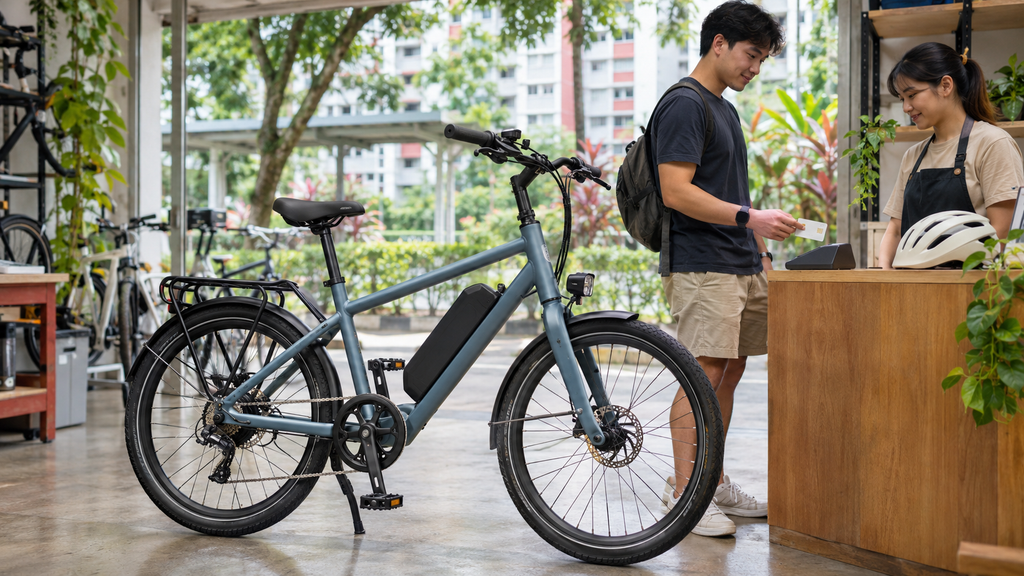
This guide explains how to compare purchase prices, identify LTA registration requirements, estimate battery replacement, servicing, accessory and charging expenses, and calculate cost per kilometre against MRT, bus and Grab journeys. It also shows how to check instalment terms without assuming that monthly payments mean the lowest total cost. Readers will learn which documents and checks to make before buying, including the LTA registration mark or seal and relevant certification.
For 2026 planning, the June 2026 LTA changes are especially important: from 1 July 2026, keeping a non-UL2272 escooter is an offence. A visible LTA registration tag or seal remains the most reliable sign that a PMD is compliant. Next, a practical PAB-versus-PMD comparison will help you build a realistic Singapore budget before choosing a device or payment plan.
Ebike Price Singapore: Compare PAB and Escooter Costs Correctly
Explain how to compare bike price bands without presenting unverified prices: use current listings and state what is included, while naturally covering “cheap ebike Singapore,” “affordable ebike” and “ebike cost Singapore.” Clarify that a PAB must meet EN15194 requirements, while an e-scooter PMD must be UL2272 certified; the available Drive S1, Drive S2 and eDegree FS1 are escooters, not ebikes, so do not describe them as PABs or quote prices beyond directing readers to check their product pages.
Upfront LTA Costs: Registration, Plate and Any Required Test Fees
When calculating the true ebike price singapore riders must pay, upfront administrative and regulatory expenses should always be accounted for alongside the retail cost of the machine. Under Singapore regulations, both power-assisted bicycles (PABs) and personal mobility devices (PMDs) require mandatory registration with the Land Transport Authority (LTA) before they can be legally used on public paths or roads. A compliant ride must also display a visible LTA registration mark or seal, which serves as physical proof of certification and vehicle identity.
Prospective riders should also budget for any applicable theory-test fee mandated for active mobility users before taking to public paths or roads. Because administrative costs can be updated periodically, consumers should verify exact fees via official LTA channels such as the OneMotoring portal rather than assuming fixed administrative rates. These regulatory outlays directly influence the baseline ebike price singapore commuters plan for when budgeting for legal ownership.
| Device Category | Certification Standard | LTA Registration & Mark | Periodic Inspection Requirement |
|---|---|---|---|
| Power-Assisted Bicycle (PAB) | EN15194 | Mandatory registration mark | None (no periodic inspection) |
| Personal Mobility Device (PMD) | UL2272 | Mandatory registration tag/seal | Every 2 years |
It is crucial to note the ongoing statutory differences between vehicle types. While PABs do not require periodic inspection after initial clearance, PMDs require an inspection every two years to remain compliant. For riders weighing their transport options, EkoLife Asia’s ebikes and LTA-approved PMD models like the Drive S1, Drive S2, or eDegree FS1 offer certified pathways to commuting across PCN networks and roads. Keeping these initial administrative requirements in mind ensures the final ebike price singapore commuters pay remains clear, transparent, and completely free of unexpected compliance fines.
Battery Replacement, Servicing and Accessories: Plan Your Ebike Cost Singapore
When calculating your total ownership budget beyond the initial ebike price singapore, ongoing maintenance, battery health, and safety gear play a decisive role. Over years of commuting along PCN networks and roads, consumable components naturally wear out. Battery capacity degrades over charging cycles, brake pads thin down, and tyres require replacement. Factoring these maintenance checkpoints into your long-term calculations ensures you are not caught off guard by unexpected repair/servicing bills.
Actual costs depend entirely on the specific make, battery capacity, and workshop rates, so riders must confirm exact pricing directly with their retailer or service provider. Safe charging and proper storage inside HDB flats are equally essential to protect your investment; always charge on hard surfaces away from exits and avoid overnight overcharging. While PABs do not require periodic inspections, PMD owners must undergo a mandatory 2-yearly inspection. For escooter riders choosing models such as the Drive S1, Drive S2, or eDegree FS1, maintaining active UL2272 certification standards through professional servicing prevents safety risks and keeps the device street-legal.
| Cost Category | Ownership Component | Regulatory & Practical Notes |
|---|---|---|
| Power System | Replacement Battery Pack | Confirm model compatibility and pricing with your retailer; check current pricing at ekolife.asia |
| Routine Maintenance | Brake Pads, Tyres & General Tune-up | Wear depends on daily mileage; crucial for wet-weather braking performance |
| Inspections | Mandatory Safety Checks | PMDs require 2-yearly inspection; PABs do not require periodic inspection |
| Accessories | Helmet, Lights & Locks | Helmets are mandatory on roads; high-lumen front and rear lights essential for night riding |
To avoid non-compliant equipment that could void your investment, never rely on verbal claims or unverified spec sheets. The single most reliable visual confirmation of compliance in Singapore is the physical LTA registration tag or seal affixed directly to the device. Verify that escooters carry the UL2272 mark and ebikes carry the EN15194 certification before committing to an ebike price singapore. Evaluating the complete picture—from upfront purchase figures to long-term upkeep—ensures you budget accurately for a compliant, dependable daily commute.
Cost per Kilometre: Compare an Ebike with MRT, Bus and Grab
To estimate an e-bike’s cost per kilometre, start with your own purchase price and the distance you realistically expect to ride over the period you plan to keep it. Add expected charging, servicing, accessories and battery-replacement costs, then divide the total by your estimated kilometres. This gives a useful ownership estimate—not a guaranteed saving. When comparing ebike price singapore options, use your expected use and maintenance assumptions rather than relying on the upfront price alone.
| Travel option | What to include | How to estimate cost per kilometre |
|---|---|---|
| Ebike (PAB) | Purchase price, charging, servicing, accessories and any battery replacement | Add estimated ownership costs and divide by expected kilometres ridden |
| MRT or bus | Your actual fares for the journey, including any transfer you make | Divide the fare for your usual trip by its approximate distance |
| Grab | The actual fare shown for the journey you take | Divide that journey’s fare by its approximate distance |
For a fair comparison, use the same origin, destination and trip frequency. For example, compare the full MRT or bus journey with an ebike trip that includes the ride to and from the station—not just the last-mile segment. If the e-bike replaces only part of a commute, compare that part with the extra fare or Grab journey you would otherwise take. Recalculate if your mileage, battery-replacement timing or servicing needs change; these assumptions can materially affect the result.
Check the rules for the device class before using a route in your estimate. PABs are allowed on roads and cycling paths, but not footpaths; they must be LTA-registered and EN15194-certified. PMD escooters are not allowed on roads and footpath: up to 25 km/h on cycling paths and PCNs. So an escooter route may not match an ebike route, particularly for MRT last-mile travel through HDB areas. A careful ebike price singapore comparison should reflect the journeys you can legally and practically make, not just the distance on a map.
Ebike Instalment Singapore: Check Payment Terms and 2026 Compliance
When comparing an ebike instalment Singapore option, look beyond the displayed monthly payment. Ask for the total payable amount across the full repayment period, including any processing or administrative fees, and confirm whether there are charges for late or early repayment. Check the repayment schedule and current eligibility criteria directly with the provider; no instalment terms or approval conditions are specified here. To understand the overall ebike price singapore, also budget for any accessories, servicing and future battery replacement, and compare the estimated cost per kilometre with your usual MRT, bus or Grab trips using your own route and travel frequency.
| What to check | Questions to ask |
|---|---|
| Total payable | What is the full amount due, including all fees? |
| Repayment period | How many payments are required, and when are they due? |
| Eligibility | What are the provider’s current approval requirements? |
| Ownership and charges | When does ownership transfer, and what fees apply for late or early repayment? |
Compliance matters as much as affordability. From 1 July 2026, keeping a non-UL2272 escooter is an offence. Before buying or keeping one, verify its UL2272 certification, LTA registration mark and plate through the LTA Active Mobility portal or current LTA guidance. A registration mark should be physically present on the device; do not rely on a payment plan or a product description as proof of compliance.
Drive S1, Drive S2 and eDegree FS1 are UL2272-certified PMDs, not pedal-assist e-bikes. Their current prices are not stated here, so check current pricing at ekolife.asia on their product pages. For browsing, see EkoLife Asia’s electric scooters or shop. Keep the full ebike price singapore comparison grounded in verified product costs and written instalment terms.
Frequently Asked Questions
What is the difference between an ebike and an escooter in Singapore?
An e-bike is generally a pedal-assist bicycle (PAB), while an escooter is a personal mobility device (PMD). PABs must meet EN15194 certification requirements and can be used on roads and cycling paths, but not footpaths; PMDs must be UL2272 certified, cannot be used on roads and. footpath, and may be used on cycling paths and PCNs at up to 25 km/h.
What LTA certification and registration mark should I check before buying an ebike or escooter?
Check for EN15194 certification on a PAB or UL2272 certification on a PMD, and make sure the device has its LTA registration tag or seal physically displayed. The tag or seal is the most reliable visual sign of compliance; you can also check a registered device by its plate number on the LTA Active Mobility portal. EkoLife product pages show compliance status, and you should check current LTA guidance for applicable rules.
Does an ebike or escooter need periodic inspection in Singapore?
PMDs require inspection every two years, while PABs do not require periodic inspection. Check current LTA sources for the latest requirements and any applicable fees.
How can I estimate ebike price singapore ownership costs and cost per kilometre?
Add the purchase price and any other costs you expect to pay, then divide that total by the kilometres you expect to ride over your chosen ownership period. EkoLife’s current product prices are listed on ekolife.asia; check current LTA sources for fees or charges not specified here.
What should I check before taking an instalment plan for an ebike or escooter?
Review the current total payable, instalment amount, payment period, and any fees or conditions in the plan before committing. Check ekolife.asia for current product pricing and instalment details, and contact the retailer if any terms are unclear.
Choose Your Ride by Total Cost, Not Just the Price Tag
A realistic ebike price Singapore comparison starts with one crucial distinction: PABs are pedal-assist e-bikes, while Drive S1, Drive S2 and eDegree FS1 are e-scooters (PMDs). PABs must meet EN15194, while PMDs require UL2272; in both cases, check the visible LTA registration mark or tag and confirm current rules before buying or keeping a device in 2026.
PABs are allowed on roads and cycling paths, not footpaths; PMDs may only use cycling paths or PCNs at up to 25 km/h. Budget beyond the purchase price for applicable registration costs, routine servicing, battery replacement and safe charging. Remember that PMDs require inspection every two years, while PABs do not.
To make a practical decision, compare your expected cost per kilometre with actual MRT, bus and Grab journeys, then review any instalment’s total payable amount, fees, repayment period and eligibility. Browse current e-mobility options at EkoLife Asia. With the right checks and a realistic ownership budget, Singapore riders can choose confidently and take the next step towards a suitable e-mobility solution.
I really appreciate how this guide breaks down the true cost of owning an ebike in Singapore, not just the sticker price. The cost-per-kilometre comparison against MRT, bus, and Grab is a smart way to see if an ebike actually saves you money. Also, the clear distinction between PABs and PMDs, plus the 2026 compliance reminders, makes it a must-read before buying.
That’s all well and good, but the guide assumes you’ll keep the bike long enough to see savings. Battery replacement alone can cost hundreds, and if you don’t ride often, the cost per km could be higher than public transport. Plus, with the 2026 rule change, compliant models might get more expensive. Is it really worth it for the average commuter?
Fair point about battery costs, but the guide does tell you to factor that in and check replacement prices upfront. For regular riders doing daily commutes, the savings add up over time, especially with COE and fuel prices rising. And compliance costs are unavoidable if you want to ride legally—better to budget for them than get fined.
You say savings add up, but what about time spent charging and maintenance? For short trips, MRT might still be faster and cheaper. The guide doesn’t really quantify the time cost.
I think both sides have a point. The guide is a good starting point, but riders need to be honest about their usage. If you’re only riding occasionally, an ebike might not be the best financial choice.
I agree with the skeptic that battery replacement is a big unknown. But I think the guide’s approach of asking the retailer about battery availability and price before buying is practical. It’s not perfect, but it’s better than ignoring the cost altogether.
Battery replacement seems like the hardest cost to predict, since it depends on how often the ride is used and how it is stored. Is there a good way to check whether a replacement battery will be available and compatible before buying?
The guide does not give a fixed battery lifespan, as battery condition depends on the model, usage and care. Before buying, ask the retailer to confirm the compatible replacement battery, its availability and current price, and include that estimate in your ownership budget.
I like that this compares the full ownership cost instead of making the cheapest listing look like the best deal. The route comparison is useful too, since an e-scooter and a PAB cannot always take the same way.
The certification and registration reminders are important, especially with the 2026 rule change coming up. I’d still double-check the latest LTA requirements before buying, because the rules and fees can change.