


foldable ebike Singapore commuters consider for the first-and-last mile needs to fit both their daily route and the rules for public transport and shared paths. Getting between an HDB estate, an MRT station and a cycling path can involve different spaces and requirements, so it helps to know whether a device is a Power-Assisted Bicycle (PAB) or a Personal Mobility Device (PMD) before planning a journey.
This guide explains the stated size limit for bringing a foldable ebike singapore onto MRT trains and public buses, and offers practical points to consider during busy commutes. It also compares PAB and PMD classifications, covers storage in HDB flats and condos, and outlines how to check registration and certification details before buying. Under the rules described for 2026, PABs can be used on roads and cycling paths, but not footpaths; PMDs can use cycling paths at up to 25 km/h. The outline also notes a change from 1 July 2026 for non-UL2272 PMDs. First, let’s look at taking a folded device on Singapore’s MRT and buses.
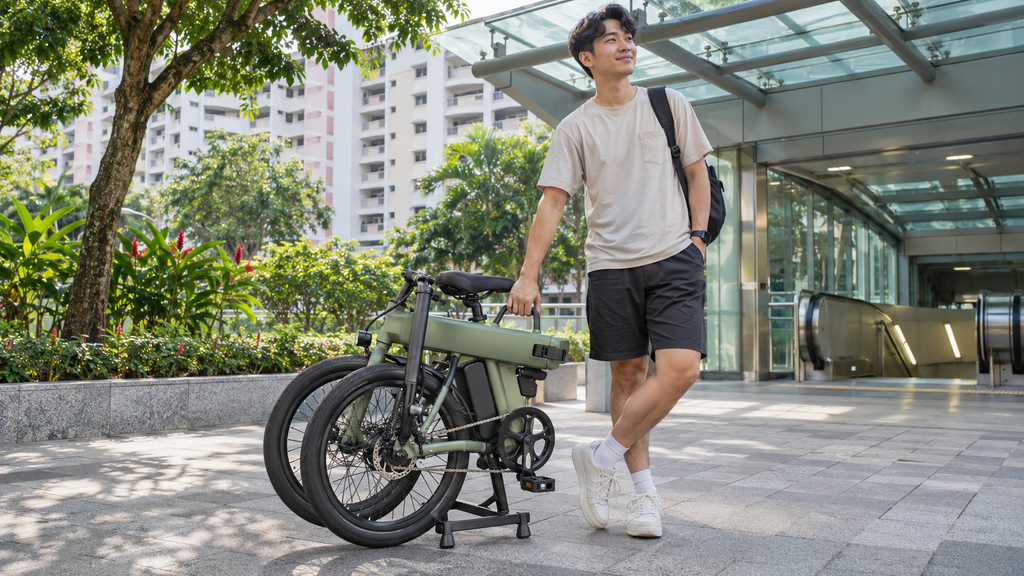
Taking Your Foldable Device on Singapore MRT and Public Buses: Rules & Dimensions
Before bringing a folded device onto an MRT train or public bus, check that it fits within the maximum size of 120 cm by 70 cm by 40 cm when folded. Measure the device in its folded state, including any parts that stick out, and do not assume that a model is permitted just because it is marketed as foldable. For anyone researching foldable ebike singapore travel options, this size check is an important first step; confirm current operator guidance if your device is close to the limit.
| Before boarding | Practical check |
|---|---|
| Folded dimensions | Keep the device within 120 cm × 70 cm × 40 cm. |
| Wheels and surfaces | Fold or cover wheels where possible, and avoid bringing dirty wheels into contact with seats or other passengers. |
| Train or bus entry | Wait for commuter flow to clear and avoid blocking doors, aisles or priority areas. |
| Busy periods | Consider travelling outside peak hours; on trains, boarding near the first or last cabin may make it easier to manage the folded device. |
At busy interchanges, pause to let passengers exit before boarding and keep the folded device close rather than letting it obstruct the walkway. This is especially helpful when transferring between MRT lines or boarding a crowded bus. When leaving an HDB block, move carefully through the void deck and lift area: keep the device under control, give pedestrians room and avoid scraping or rolling dirty wheels across shared spaces.
Foldability does not replace the rules for using the device outside public transport. For example, a PAB is allowed on roads and cycling paths, not footpaths. If you are comparing options for a foldable ebike singapore commute, verify the actual folded dimensions and weight for the specific model before purchase; these details are not provided for the products listed here. Check current transport-operator guidance for any updates before travelling.
Foldable Ebikes Singapore (PABs) vs Compact Escooters (PMDs): Clarifying Singapore 2026 LTA Rules
For a foldable ebike singapore commute, folding the vehicle does not change its LTA category or automatically confirm that it can be carried on public transport. Before taking any device on the MRT, check the current operator requirements and the device’s folded dimensions; do not assume that “compact” means it is permitted onboard. For HDB or condo storage, also check that you can manoeuvre and store it safely.
The key distinction is whether the vehicle is a pedal-assist bicycle or an escooter. A PAB must be EN15194-certified, has a maximum 250 W motor and a 25 km/h motor cut-off, and is allowed on roads and cycling paths—not footpaths. A PAB must be LTA-registered and display its registration mark, but it does not require periodic inspection. A PMD must be UL2272-certified and LTA-registered, with its registration mark displayed. It is not allowed on roads and footpath, and PMDs require inspection every two years.
| Check | PAB (pedal-assist e-bike) | PMD (e-scooter) |
|---|---|---|
| Certification | EN15194 | UL2272 |
| Motor and speed limits | Maximum 250 W; motor cut-off at 25 km/h | Maximum 500 W; maximum 25 km/h on cycling paths and PCNs |
| Where permitted | Roads and cycling paths; not footpaths | Cycling paths and PCNs; not roads and footpaths |
| Periodic inspection | Not required | Required every two years |
From 1 July 2026, keeping a non-UL2272 e-scooter is an offence. When assessing a foldable ebike singapore option—or a compact scooter—check the certification marking and physically look for the LTA registration tag or seal; this is the most reliable visual compliance check. EkoLife Asia’s listed UL2272-certified PMDs include the Drive S1, Drive S2 and eDegree FS1. These are escooters, not PABs. For current pricing, check current pricing at ekolife.asia.
HDB Living & Condo Storage: Folded Dimensions, Weight, and Fire Safety
Discuss practical storage challenges in Singapore apartments, including navigating narrow HDB lifts, avoiding corridor clutter under Town Council guidelines, and compact balcony or under-desk placement. Stress the critical importance of UL2272 certification for PMDs and EN15194 certification for PABs to ensure safe battery charging at home. Highlight the necessity of checking the physical orange LTA seal before parking or charging indoors
How to Verify LTA Compliance Before Buying in Singapore
Ensuring your active mobility device meets local standards is essential before riding on public infrastructure. If you are exploring a foldable ebike singapore setup or an alternative Personal Mobility Device (PMD), purchasing an unapproved or modified model carries severe penalties, including equipment confiscation and hefty fines. The single most reliable visual proof of legality is the physical LTA registration mark (seal or tag) affixed directly to the frame. Without this registration mark, the device is not legally compliant for Singapore usage, regardless of claims made on an online listing.
When evaluating a potential foldable ebike singapore commuter or micro-mobility device, look for the correct electrical and mechanical safety certifications. Power-Assisted Bicycles (PABs) must be certified under the EN15194 standard, feature a maximum continuous motor rating of 250 W, and provide motor assistance only up to 25 km/h cut-off. By comparison, certified PMDs like the Drive S1 E-Scooter, Drive S2 E-Scooter, or eDegree FS1 E-Scooter must carry UL2272 certification, stay under 20 kg unladen weight, and limit motor power to 500 W.
| Verification Checkpoint | Power-Assisted Bicycle (PAB) | Personal Mobility Device (PMD) |
|---|---|---|
| Safety Certification | EN15194 standard marking | UL2272 standard marking |
| Physical LTA Mark | LTA registration plate/seal affixed | LTA registration mark/tag affixed |
| Maximum Motor Rating | 250 W (cut-off at 25 km/h) | 500 W |
| Permitted Paths | Roads and cycling paths (NOT footpaths) | Footpaths (max 15 km/h), Cycling paths (max 25 km/h) |
| Inspection Rules | No periodic inspection required | Mandatory 2-yearly inspection |
To verify ownership and compliance status independently, check the device registration number via the OneMotoring Active Mobility portal (onemotoring.gov.sg). Steer clear of parallel imports or private sellers offering unverified units with aftermarket throttles. Confirming official markings beforehand ensures your foldable ebike singapore journey remains safe, legal, and hassle-free across Singapore’s roads and cycling path networks.
- Verify that the LTA registration tag or seal is physically secured to the frame before completing payment.
- Cross-reference the serial plate against the OneMotoring portal to ensure active, legal registration.
Frequently Asked Questions
Can I bring a foldable ebike in Singapore on the MRT and buses?
Yes, foldable PABs and PMDs are permitted on MRT trains and public buses as long as they are folded and within allowable dimensions. Ensure your device is switched off and wheeled or carried safely without obstructing other commuters, especially during peak hours. For specific model dimensions and compliance status, check the product details on ekolife.asia.
Do PABs require periodic LTA inspections like PMDs?
No, PABs (ebikes) do not require periodic inspections in Singapore. In contrast, PMDs such as the UL2272-certified Drive S1, Drive S2, and eDegree FS1 require an LTA inspection every 2 years. However, both device types must be properly registered with LTA and display an official registration mark.
How do I confirm if my e-mobility device has a genuine LTA registration mark?
The most reliable visual check is the physical LTA registration tag or seal affixed directly to the device. You can also verify the registration number via the LTA OneMotoring portal to ensure it matches the vehicle details. PMDs must display UL2272 certification markings, while PABs must show EN15194 compliance.
Where can I legally ride an ebike compared to an escooter in Singapore?
PABs (e-bikes) are legally permitted on roads and cycling paths or PCNs, but are strictly prohibited on footpaths. Escooters (PMDs) are allowed on cycling paths/PCNs up to 25 km/h, but are never allowed on public roads and footpath. Always check path markings around your HDB estate to ride legally.
Choosing the Right First-and-Last Mile Companion for Singapore Commutes
A foldable ebike like the Jimove MC Pro 2.0 can make the journey between an HDB estate, an MRT station and the PCN more convenient, but portability is only part of the decision. Before buying, check that the folded device fits the stated public-transport size limit, can be stored safely at home and suits the routes you actually travel. A little measuring and route planning can help avoid an inconvenient mismatch.
Be clear about the difference between a PAB and a PMD, and verify the device’s compliance details before purchase. The LTA registration tag or seal is the most reliable sign to check. Remember that PABs are allowed on roads and cycling paths, not footpaths; PMDs may use cycling paths or PCNs at up to 25 km/h. Check official information if you are unsure about a device or route.
For a useful next step, explore EkoLife Asia’s PAB collection and review the relevant product specifications as you compare your options. With the right fit, clear compliance checks and a commute planned around Singapore’s paths and transit, you can make your daily first-and-last mile simpler and more confident.